Showing posts with label David Aune. Show all posts

Sunday, November 2, 2014

Lucian's "The Ignorant Book Collector:" When a Classic Hits a Little too Close to Home

My former professor and good friend David Aune recently passed on to me a generous selection of some of the volumes he had collected from the Loeb Classical Library. I was thrilled to receive this kind gift since, as a doctoral student, I had only been able to acquire but a bare minimum of Loeb volumes, and in the intervening years, I have had little need to enhance my collection (being close to a university library at all times). But since my graduate student days I, like many, had become enamored with the sharp wit and incisive prose of Lucian (a second century Greek writer and satirist). My favorite was his "Alexander the False Prophet," and I am proud to say that I did already own the volume that contains that piece. So I was thus quite delighted to find among the volumes that David sent me volume three of the eight volumes of Lucian included in the LCL. Given my predilection for Lucian, this was the first of the volumes David sent me that I chose to spend some time looking through (with my apologies to Homer and Plutarch). On perusing the table of contents I was intrigued to find an essay entitled "The Ignorant Book Collector." As expected, the essay highlights the folly of an individual who prides himself in acquiring a large library of fine volumes in the hopes that he will gain a reputation as a learned and wise man among his peers. As I prepare to unload these green and red Loeb volumes onto my own office shelves, I cannot help but pause to consider the irony of having received this fine set of books in which the first thing I read is an essay which criticizes book owners who are not worthy of the books they possess. And so I'll quote Harmon's translation of a particular convicting paragraph of this essay:
What good, you strange person, will it do you to own them, when you do not understand their beauty and will never make use of it one whit more than a blind man would enjoy beauty in favourites ? To be sure you look at your books with your eyes open and quite as much as you like, and you read some of them aloud with great fluency, keeping your eyes in advance of your lips; but I do not consider that enough, unless you know the merits and defects of each passage in their contents, unless you understand what every sentence means, how to construe the words, what expressions have been accurately turned by the writer in accordance with the canon of good use, and what are false, illegitimate, and counterfeit. (Lucian, Vol. 3, LCL, p. 177 trans Harmon)
Ouch. To be sure, Lucian raises a high standard of what it would take to really be counted as a learned and erudite reader of ancient texts. I don't dare to hope to go so far as to "know the merits and defects of each passage" in my new collection of Loeb volumes. But I am reminded by his sarcasm and wit, once again, that the value of the classics for a scholar of Christianity and Judaism in antiquity is not so much in understanding the origins of key words or interesting parallels or giving in to "parallelomania," but rather in coming to grips with the thought world which informs ancient Greek and Roman authors of all stripes. With such a broad understanding, scholars of early Judaism and early Christianity can more fully appreciate the world in which educated Jews and Christians contributed their own works and can more effectively articulate the kind of meaningful connections by which these authors engaged the thoughts and hopes and fears of that world in light of their understanding of the actions of the God of Israel in history.

Accordingly, I am grateful to David for this kind gift. And I am energized, once again, as I aim not to be deserving of being counted as a distant descendant of Lucian's ignorant book collector, but instead to be counted among those who truly benefit from wide reading. Not to be known as someone with a passion for expensive books, but rather to be known as one who has begun to take the time to understand these books in ways that open up understanding and enhance my ability to think carefully, critically, and creatively. But for now, I should probably set as my first goal just to unpack the boxes and start reading.

Friday, July 18, 2014

Forthcoming Article on Paul and Rhetoric

I just received word that an article of mine will appear in the Journal for the Study of Paul and His Letters this fall or early winter. My article "Galatians and the Progymnasmata on Refuting a Law: A Neglected Aspect of Pauline Rhetoric" examines the ancient classroom exercise on how to introduce a law or refute one, and then considers the extent to which Paul utilized the kinds of arguments that this exercise promoted. This is a topic that was originally suggested to me by professor Jerry Neyrey in a doctoral seminar at the University of Notre Dame in 2003 and that I finally began working on a few years ago.  I am grateful to Jerry for the suggestion, and also to David Aune for taking the time to read and comment on a draft of this article. The abstract is below, and when the issue is published I'll post the link.

The structure, flow, and logic of Paul’s argumentation in Galatians continues to be a subject of debate as scholars seek to read Paul’s statements about the law, works of the law, and other aspects of Judaism within a framework which appreciates both the diverse nature of first-century Judaism as well as Paul’s appropriation of his own Jewish heritage. Scholars have also sought to read Paul’s letter to the Galatians in light of first-century Greco-Roman rhetorical strategies and conventions. This essay contributes to these discussions by looking at Galatians from an angle that has not yet been considered: the first-century CE progymnasmata exercise on the introduction and refutation of a law (νόμου εἰσφορά). This specific compositional exercise drew on the skills mastered in earlier exercises as students utilized compositional and rhetorical skills to persuade the reader (an imaginary audience) to enact or abandon a particular law based on the topics of legality, possibility, advantage, and appropriateness. By reading Galatians through the lens of this particular exercise, it is possible to appreciate the extent to which Paul utilized conventional forms of argumentation about the application of existing laws. Such a reading contributes to a thicker description of Paul’s utilization of elements of ancient rhetoric.

Monday, October 7, 2013

David Aune on Galatians 3:28 and the Problem of Equality


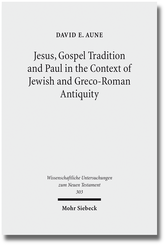
New Testament scholars in a variety of specialties will be pleased to see that a second collection of the essays of David Aune has been released this year by Mohr Siebeck: Jesus, Gospel Tradition and Paul in the Context of Jewish and Greco-Roman Antiquity. I will say more about this rich volume as a whole in a later post. For now I focus on the final essay of this volume, “Galatians 3:28 and the Problem of Equality in the Church and Society” (pp. 524-549), in which David Aune provides some important context for understanding the notion of equality in Christ that Paul outlines in Gal 3:28. The real heart of the issue is the extent to which Paul was only advocating a kind of equality coram deo (before God) in which all have equal access to the possibility of being “in Christ” but which has no significant impact in concrete social relationships; or whether Paul was suggesting that this equality before God must also be somehow physically manifested in concrete social relationships between males and females, slaves and free, Jews and Gentiles, within the churches.

To shed light on Paul’s views, Aune reviews the teaching and example of Jesus with regard to equality and the erasing of hierarchical distinctions. He also reviews contemporary Jewish and Greco-Roman views on each of the relationships of the Gal 3:28 triad: Jew/Gentile, slave/free, male/female.

Most illuminating is comparing Gal 3:28 with what Paul says elsewhere about these distinctions. Notably, in 1 Cor 7 Paul addresses each of the three elements of this triad of conventional hierarchies. Further, by reading Gal 3:28 in light of Paul’s conflict with Peter over table fellowship between Jews and Gentiles (Gal 2:11-14), Aune suggests that Paul fully expected that the abolishment “in Christ” of these conventional social hierarchies would be played out in practice in the real relationships of believers with one another. 
“The very fact that Paul thought national differences were irrelevant for those who belonged to the new people of God suggests that the two other areas of equality, ‘neither slave nor free’ and ‘neither male nor female,’ not only reflect equal status before God, they also signal changed attitudes toward others that ought to prevail in the life of the Church” (549)
Paul’s letter to Philemon offers another concrete instance of Paul’s expectation that being “in Christ” would have concrete implications in the relationships of Christians with one another. How the tensions this expectation created would be resolved is not so clearly addressed by Paul (at least not in the case of Onesimus and Philemon). Aune explains,
“While Paul does not resolve the tension that would have existed between those two quite different roles [i.e. being a slave in the flesh vs. being a spiritual brother in Christ], a transformation of social relationships is surely in view” (549).
Aune thus provides a helpful way of positioning Paul within his first-century context and within the context of early Christian writers. Paul, though surely influenced by the conventions of his day, points to a new way of relating to one another within the community of believers. The dynamic tensions inherent within these new ways of relating will, it seems, need to be addressed in the day to day lives of each new generation of believers who live within the social structures of the world but also find themselves “one in Christ Jesus.”