Showing posts with label sacredness of creation. Show all posts

Thursday, February 27, 2025

Celebrating Black History and Learning from Martin Luther King, Jr.'s Mentor

In honor of Black History Month here is a reflection that I read at a university leadership meeting on MLK day a few years ago. In it I draw attention to a figure you may not be familiar with. You may know something of Howard Thurman, but I knew very little until doing research for my book on the parables and social justice. Thurman was an author, preacher, philosopher, theologian, and civil rights leader. He held academic posts as dean of the chapel at Howard University and Boston University, and also founded an interdenominational church in San Francisco. He has been called “a spiritual genius who transformed persons who transformed history” (Smith, xi). His particular relevance today is that he was a mentor of Dr. Martin Luther King, Jr. It was reported that Dr. King always carried a copy of Thurman’s book, Jesus and the Disinherited, whenever he traveled. John Lewis and the freedom riders also circulated Thurman’s writings to encourage one another. In reading Thurman, it is really interesting to see the insights behind some of Dr. King’s powerful statements. As a leader at a Sisters of Mercy university, it is interesting too to see links with the teachings of the Sisters of Mercy.

Here I share five insights from Thurman and make some linkages to Dr. King, and to our work today at a Catholic, Mercy university.
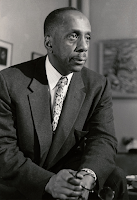

Source: Howard Thurman: The Overlooked Civil Rights Hero
First, Thurman’s approach to social justice starts from the place of the value of each person. Each person has inherent worth as a child of God. Furthermore, this value is independent of social location, economic status, race or any other markers. For Thurman, this is the sense of identity as a child of God. At my university we speak of the value of the Sacredness of Creation which recognizes that we each hold this inherent value as children of God.

Second, for Thurman, this leads to a goal in human life of freedom to self actualize. To grow, to live, to live fully out of the center of who one is. A quote of Thurman’s you may have heard is this one: “Don’t ask what the world needs. Ask what makes you come alive, and go do it. Because what the world needs is people who have come alive.” 

Third, recognizing this inherent value for oneself, one must also recognize this reality for others. And with this recognition comes a twofold threefold obligation: to work toward community (love); to support the freedom to live and grow for others (mercy); and to work against forces of oppression and dehumanization (justice). Ultimately, this amounts to working toward a community in which all may thrive; what Martin Luther King, Jr., called the “beloved community.”

Fourth, this activity is supported by the recognition of the inter-connectedness of all of life—humans and creation, because all of it is God’s creation, created out of love. So genuine religion, and in particular genuine Christian faith, aligns with love and fosters a sense of obligation for the well-being of all in the present world, regardless of its apparent brokenness.

Fifth, for Thurman, Jesus was the ultimate example of this, as well as the ultimate teacher. Coming into the world and living, teaching, and dying with the Jewish people under the domination of the Roman Empire, among the oppressed, his was a message for the disinherited. That they could live effectively in that chaos with the recognition that they were children of God. The kingdom of God that Jesus proclaimed could be defined broadly as the conceptual space in this world where God’s highest values are enacted in human lives. Put more simply, the kingdom of God is the enactment of and participation in loving community. 

With those five points as background, I would like to return to one of Dr. Martin Luther King, Jr.’s, quotes that has resonated with me in recent years. The quote is from his Letter from a Birmingham Jail, April 16, 1963. “Injustice anywhere is a threat to justice everywhere. We are caught in an inescapable network of mutuality, tied in a single garment of destiny. Whatever affects one directly, affects all indirectly.” There is a lot of Howard Thurman behind this. In addition, King’s concept of the beloved community is one that is undergirded by Thurman’s insights on the value of all people, and the critical importance of working toward a community which supports all its members, and in which each person is free to thrive.

Having worked at a Sisters of Mercy university for ten years, it is so interesting to see that these statements connect at a deep level with the Sisters of Mercy concept of a more just and merciful world. They also resonate with Catholic Social Teaching and in particular the theological virtue of solidarity—a virtue which is much needed in our present, fractured world.

Bryan Massingale is a contemporary scholar who writes on racial justice and the Catholic Church and also points to the importance of solidarity. He cites Pope John Paul II who defined solidarity as a “firm and persevering determination to commit oneself to the common good; that is to say to the good of all and of each individual, because we are all really responsible for all” (116). Massingale also used King’s words to explain that “solidarity is based on the deep-seated conviction that the concerns of the despised other are intimately bound up with our own, that we are, in the words of Martin Luther King Jr., ‘bound together in a garment of mutual destiny’” (116). Massingale also notes, “Solidarity entails a constant effort to build a human community where every social group participates equitably in social life and contributes its genius for the good of all” (117). These words inspire a powerful vision for the kind of world we all would like to live in.

As we wrap up our celebration of Black History Month may we all remember the legacy of leaders who have come before us, may we acknowledge the work still to be done in the struggle against the evil of racism, and may we make every effort to live into the best aspects of the rich heritage which we have each been given as we face the challenges of this moment.

Sunday, January 19, 2020

Racism, Violence, and Discrimination versus the Sacredness of Creation


While the first week of the new term is always filled with stress and uncertainty of new classes mixed with the anticipation of new things ahead, this past week held something else: challenging thoughts for the new year. Three different events were held on campus this week that showcase what we mean at Carlow University when we talk about respecting the dignity of every human being--a concept that is closely related to the core value of focus for Carlow’s 2019-20 academic year, “Sacredness of Creation.” As I have noted in another post, this value is not just about respecting the world around us, but also about recognizing that every person we encounter is a unique creation of God. Thus we honor the “Sacredness of Creation” when we recognize the presence of God in every person, and when we treat all people with the dignity they deserve. Three events this week brought this idea into sharp focus as they addressed issues of racism, violence, and discrimination.

The first was a student panel in honor of Martin Luther King, Jr day, co-hosted by the Social Justice Institutes and the College of Leadership and Social Change. The event was entitled “Disruptive Empathy” and began with psychology faculty member, Dr. Pat Jameson, sharing from her research in relational cultural theory—a framework in psychology which promotes the benefits of empowering relationships in contrast to the destructive dynamics of power/over relationships. Notably, she began with mention of the concepts of justice and mercy that we focus on in our Contemplation and Action courses. Specifically, the idea that justice is "finding out what belongs to whom, and giving it back" (citing Walter Bruggeman). In this case: the respect and human dignity that every person deserves. Her comments set the stage for students' talking about their experiences of marginalization based on their multiple identities whether related to gender, race, sexual orientation, religion, or even place of origin. They also spoke about where they sought strength and encouragement, and gave some really thoughtful insights into ways the Carlow community might move forward to become even more of a place where “all are valued and all may thrive.” A key takeaway for all attendees was the advice to listen, really listen, to what our students of color, as well as other individuals with identities which are prone to be marginalized by the majority culture, have to say. And in that listening, not assume that "we" (ie the majority culture) know what those individuals are going through or what they need.

The second event was a faculty and staff training opportunity led by our Student Affairs leaders and chief of police around the university’s new Green Dot training. Green Dot is a bystander awareness and intervention program aimed at producing a culture change related to interpersonal violence whether sexual violence, intimate partner violence, or stalking. The purpose of the faculty and staff session was to share the details of the program with the community prior to its being rolled out with students. Part of the key to this program is having a campus culture that reinforces the message that violence is not ok and that everyone does their part to promote a safe campus. Rather than just a one-time training or seminar, Green Dot looks to be a very comprehensive and multi-pronged approach aimed at culture change. From the statistics that were shared, the program produces measurable and meaningful results where it has been used. A key insight was the idea that there are many ways to intervene in situations where someone may be in danger, and these range from simple distraction to delegation (finding someone in a suitable position or relationship to address the problem) to direct involvement. With awareness of the scope of the problem and with a range of tools in hand, members of our community can be better prepared to respond to a questionable situations where an individual’s safety may be in jeopardy.

The third event was a faculty lecture by Dr. Clara Cheng related to her research on implicit bias. Her talk was part of the President’s Lecture Series celebrating Carlow’s 90th anniversary and showcasing Carlow’s faculty expertise for the university and the broader community. Dr. Cheng did some myth-busting based on her extensive research and explained that implicit bias is something everyone has and that it is absorbed from the culture around us. Further, the problem with implicit bias is that it leads (even if unintentionally or unconsciously) to real impact in peoples’ lives. Dr. Cheng referred to research studies related to school achievement, college admission, job applications, career success, health care, criminal justice, and engagement with police officers, as areas where implicit bias impacts outcomes in very disparate ways for different groups. One recommendation from her talk was to recognize that implicit bias is a habit—and like any habit, if we work at it we can break it. When we catch our minds moving down a well-worn path of judgment of someone who is different from us, we can take the small step to replace biased thoughts about a person we encounter with a neutral thought.

Most encouraging to me about these events was the attendance—by faculty, students, and staff. During a very busy week, all three had better turnout than I have seen at many other open events addressing needs in the campus community. With this level of interest, and the rich content of challenging ideas shared, we all have a lot to think about as we seek to live in ways that recognize and honor the value of each person we encounter. And what a worthy goal to work toward in the new semester, new year, and new decade.

Sunday, September 1, 2019

Connecting the Sacredness of Creation with Liberal Arts and Social Justice

Carlow University where I teach identifies five cores values that underlie all that we do: mercy, service, hospitality, discovery, and sacredness of creation. This academic year the value of sacredness of creation is being called out for special attention. Since I’ve been thinking about this value and its implications for what we do in the College of Learning and Innovation, I wanted to capture some of these ideas in a short post.

In Carlow’s values statement the value of sacredness of creation is described in this way:

This value leads us to a respect for each person and for all of creation. In gratitude for the beauty and variety of our world and its inhabitants, we commit to a culture of sustainability and to the preservation of a world where all are reverenced and all may thrive.

Since Carlow is a Catholic, Mercy institution, this value can be seen as a clear theme drawn from the Catholic Intellectual Tradition and underlying Catholic Social Teaching. As such, it is really an outgrowth of the biblical understanding that this world is God’s world. Psalm 24 begins with this declaration: “The earth is the LORD's and all that is in it, the world, and those who live in it.” Careful reflection on this annunciation alone would allow us to make a strong claim for the value of all that is in this world, and of all who live in it. Rooted in the Hebrew Bible and affirmed in the New Testament, the sacredness of all creation is arguably a central affirmation of both Jewish and Christian faith traditions.

As a starting point, this value is a clear call to living thoughtfully upon the earth in ways that respect and preserve the beautiful world that we live in. As important as that is, especially today, it also seems to me the sacredness of creations has implications far beyond environmental responsibility.

I see this value making a claim upon our work in the College of Learning and Innovation in two important ways. First, on the largest possible scale, because everything that exists does so by God’s creative will, everything in this world is inherently valuable. This orientation to seeing the world as sacred undergirds the importance of a liberal arts education. Every field of academic study has value for its own sake, if we embrace the value of the sacredness of creation. Fr. Michael Himes of Boston College uses a wonderful expression to speak about what he calls the sacramental principle. He says, “To see things as they are is to see them ‘engraced.’ Everything that is, exists by being held in love by ‘engracement.’” If the earth is the Lord’s, then everything is “engraced”—what is needed is for us to be able to perceive this. This leads to a second implication.

Second, on a more personal scale, the sacredness of creation reflects back on the value, worth, and dignity of every person. This value certainly necessitates that we treat all people with the dignity they deserve. But this value places an additional claim on us: if we hold this value then we are called to respond to situations in which the dignity of humans is violated. Valuing the sacredness of creation thus places an obligation upon us to address social injustices. Catherine McAuley, foundress of the Sisters of Mercy, spent many years of her life living with a Quaker family where she came to embrace the Quaker teaching that “there is that of God in every person.” That belief motivated her life of service and continues to animate the Sisters of Mercy to this day. And thus, this value of the sacredness of creation is deeply rooted in our university’s history.

In short, in this one value is inscribed not only the importance of living with an eye toward the preservation of our environment, but a theological foundation for the study of the liberal arts and for working for the well-being of all people.